

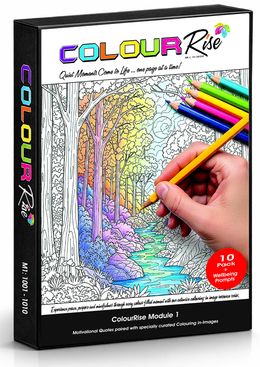
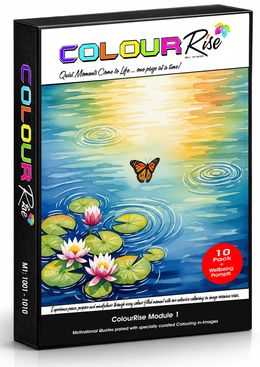

Simply, calm your nervous system, peacefully ... just colouring one page at a time!
 About ColourRise
ColourRise was created to meet people where they are - overwhelmed, disengaged, anxious, overstimulated or simply needing a gentler way to reconnect with themselves.
Blending mindfulness-based colouring, guided reflection and evidence-informed therapeutic principles, ColourRise offers a structured yet accessible program that supports emotional regulation, focus and psychological wellbeing. It’s not about artistic skill - it’s about slowing the nervous system, creating moments of calm and building insight through simple, repeatable practice.
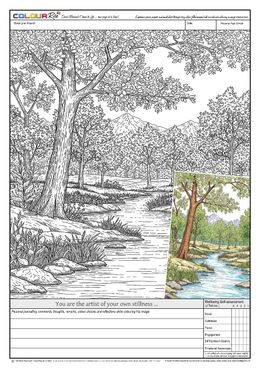
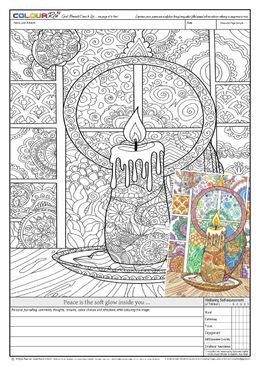
Each ColourRise series/module is thoughtfully designed for real-world settings - from homes and clinics to aged care, disability services and correctional facilities - making it easy to engage with independently or alongside professional support. The program aligns with principles drawn from CBT, trauma-informed care and mindfulness research, while remaining non-clinical and welcoming for participants who may struggle with traditional talk-based approaches. As part of the ColourRise creative wellbeing program images are specifically curated as synthetic media.
For individuals, ColourRise is a grounding ritual - something to look forward, hours of quiet time and enjoyable activity, daily/weekly.
For professionals, it’s a practical, low-barrier tool that enhances engagement, supports therapeutic goals and fits seamlessly into existing care frameworks.
Simple. Human. Evidence-informed.
ColourRise isn’t just colouring - it’s a pathway to calm, clarity and connection, one page at a time.
NDIS Provider Reg: 4-LN4GWAY (Item 0112) ABN: 61 547 369 263 Australia
Trade mark protection for ColourRise™ is currently being progressed through IP Australia.
Plan Manager / NDIS Funding Justification – ColourRise
Support description:
ColourRise is an evidence-informed, mindfulness-based colouring program used as a low-intensity wellbeing and capacity-building support. It is designed to assist participants with emotional regulation, routine building and self-management strategies through non-verbal, self-directed engagement.
NDIS alignment [ NDIS Provider No: 4-LN4GWAY ]:
ColourRise may align with NDIS Item 0112 (Wellbeing & Capacity-Building Supports) where it supports the participant’s stated goals and meets reasonable and necessary criteria.
How this support assists the participant:
- Supports emotional regulation and calming strategies through structured, repetitive and grounding activity
- Builds independent self-management skills rather than reliance on ongoing direct supports
- Encourages routine and consistency, supporting functional capacity and daily participation
- Provides a non-verbal option suitable for participants with communication challenges, psychosocial disability or neurodivergence
- Is low risk, low intensity, and trauma-aware, suitable as an adjunct to existing supports
Use context:
ColourRise can be used independently by the participant or with minimal support in the home, community or supported environments, increasing flexibility and continuity across settings.
Clinical positioning:
ColourRise is not a clinical therapy or medical treatment. It is an evidence-informed wellbeing support that complements - but does not replace - therapeutic or clinical interventions.
Value for money:
As a reusable digital resource, ColourRise represents a cost-effective support that can be accessed repeatedly over time, supporting ongoing wellbeing without the need for increased funded hours.
Contact us for bulk licensing and/or digital download for organisations pricing.
Funding note:
Approval of this support is subject to individual plan goals and the discretion of the plan manager in accordance with NDIS reasonable and necessary criteria.
What Can NDIS Funding Be Used For at Home?
Low-Cost Wellbeing Supports That Build Routine, Calm and Daily Engagement
If you or someone you support is navigating the NDIS, one of the most common questions is:
“What can NDIS funding actually be used for day-to-day at home?”
Beyond appointments and formal therapies, many participants experience long periods of unstructured time - leading to boredom, low mood, anxiety and disengagement.
This is where self-guided wellbeing supports are becoming one of the most effective, low-cost ways to build consistency, emotional regulation and independence.
NDIS Activities for Mental Wellbeing, Routine and Daily Engagement
Participants, carers and support coordinators are increasingly searching for:
- NDIS activities at home
- NDIS supports for anxiety and stress
- NDIS daily routine supports
- NDIS ideas for adults with downtime
- NDIS low cost supports under $1500
- NDIS self-managed plan ideas
The challenge?
Most available supports are either:
- High-cost and appointment-based
- Clinically focused and overwhelming
- Difficult to maintain consistently
What’s often missing is a simple, structured, repeatable activity that participants can engage with independently.
A Different Approach: Structured, Self-Guided Wellbeing Programs
A growing shift within NDIS supports is toward:
Low-intensity, non-clinical wellbeing tools that support daily life - not just appointments.
These supports focus on:
- Emotional regulation
- Routine building
- Reducing anxiety and overwhelm
- Creating a sense of purpose
- Encouraging consistent engagement
One example of this approach is a weekly guided activity system designed to be completed independently or with minimal support.
Introducing a Self-Guided Wellbeing Activity System
This type of support is not therapy.
It is a structured, guided wellbeing program that helps participants:
- Engage in meaningful activity each week
- Develop routine and predictability
- Support emotional balance
- Reduce idle time and disengagement
- Build confidence through completion
Each session is designed to be:
- Simple and accessible
- Calm and non-triggering
- Repeatable and structured
- Suitable across a wide range of abilities
Why This Matters for NDIS Participants
Many participants are not looking for more appointments.
They are looking for:
- Something to do between supports
- A way to manage stress independently
- A structured weekly activity
- A sense of progress and achievement
This is particularly relevant for:
- Psychosocial disability
- Anxiety and stress-related conditions
- Autism and sensory regulation
- PTSD recovery programs
- Aged care and cognitive support
- Participants living independently or with limited supports
Is This Covered by NDIS?
Depending on your plan and goals, structured wellbeing tools like self-guided activity programs may be claimed when they support:
- Daily living skills
- Emotional regulation
- Increased independence
- Routine and structure
- Community and social participation (indirectly)
These supports may align with:
- Core Supports (Assistance with Daily Life)
- Capacity Building supports
- Assistive products (where a tangible resource is supplied)
Always check with your support coordinator or plan manager to ensure alignment with your individual plan goals.
Low-Cost NDIS Supports That Actually Get Used
One of the biggest challenges in the NDIS space is not access to funding - it’s consistent usage of supports.
High-performing supports share common characteristics:
- Easy to start
- No appointment required
- Low pressure
- Repeatable each week
- Visually engaging and calming
This is why structured, self-guided programs are gaining traction as a high-value, low-cost support option.
Designed for Real-World Use (Not Just Theory)
Unlike one-off activities or passive entertainment, structured wellbeing programs are designed to:
- Build habit over time
- Reinforce routine
- Encourage completion and progression
- Support long-term behavioural consistency
This makes them highly suitable for:
- Support workers to implement during shifts
- Carers needing reliable engagement tools
- Participants managing their own schedules
A Smarter Way to Use Your NDIS Plan
If you are self-managed or plan-managed, incorporating low-cost wellbeing supports into your plan can:
- Extend the life of your funding
- Reduce reliance on high-cost services
- Improve day-to-day quality of life
- Support independence between formal supports
Explore a Structured Wellbeing Approach
If you are looking for:
- NDIS activities at home
- Supports for anxiety and stress
- Daily routine and engagement tools
- Low-cost NDIS supports that are easy to use
Then a structured, self-guided wellbeing program may be a valuable addition to your plan.
Subscribe to our newsletter
Get the latest news and updates straight to your inbox